Tianze Hu

I recently graduated with a B.S.E. in Mechanical Engineering from the University of Michigan and will join Northwestern University as an incoming Ph.D. student in Mechanical Engineering in September 2026. My undergraduate work sat at the intersection of soft robotics, bio-inspired robotics, mechanical computation, and textiles. I built pneumatic fabric circuits that embedded sensing, logic, and actuation directly into inflatable devices, helped develop a snail-inspired robot that collected microplastics from lakes, and designed porous monolith concepts for mitigating toxic gases from EV battery thermal runaway. Those projects shaped my interest in structures that can think and act with minimal electronics, especially in wearable assistive devices and sustainable environmental robots.

I enjoy meeting people with diverse backgrounds and ideas—feel free to reach out by email if you’d like to chat or collaborate.

Tianze Hu

Research & Project Spotlight

Fabric Logic Library: A Framework for Integrated Mechanical Circuitry in Smart Pneumatic Fabrics

Hu, T., et al. (2026). Journal of Intelligent Material Systems and Structures (JIMSS), OnlineFirst.
https://doi.org/10.1177/1045389X261433617

To enable predictable, electronics-light control in soft robots and wearables, I developed first-principles models and Simscape/Simulink simulations for a fabric-native library of pneumatic logic elements, including cotton resistors, channels and vias, pouch capacitors, and kink valves. I created a fabric-transistor abstraction, designed model-sized ring oscillators, and validated the predictions against hardware, with period-pressure trends matching experiment within 20% error. The resulting blockset and design charts supported rapid, simulation-first system design for integrated fabric logic.
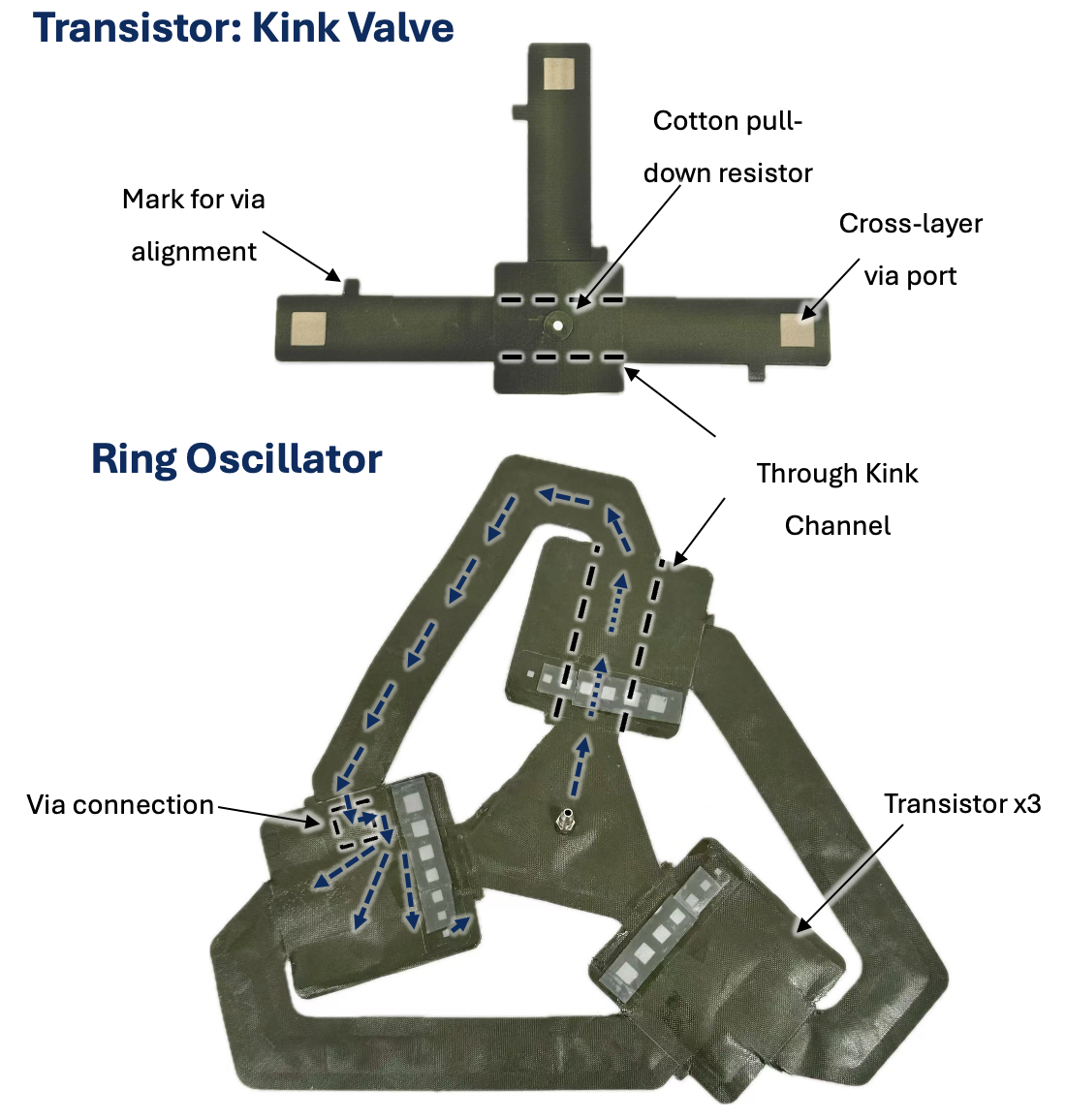
Fabric logic library research figure

Pneumatic Fabric Logic: Logic Gates and Memory in Laminated Textiles

T. Hu, T. Li, K. Benli, J. Luntz, D. Brei.
Presented at UM Mechanical Engineering Undergraduate Symposium 2024 & 2025 (Best Poster Award 2024)

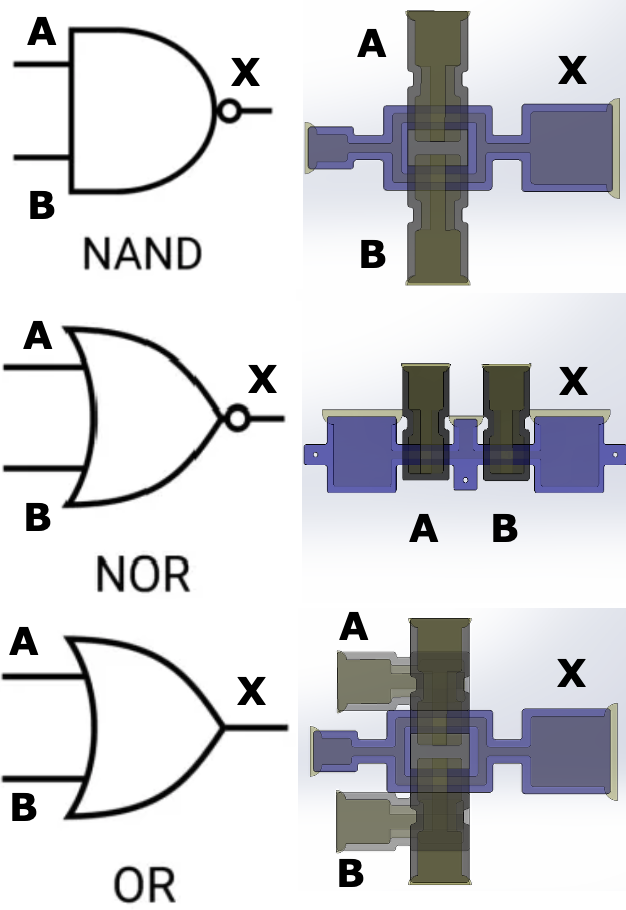
I developed and characterized a laminated fabric kink valve as a pressure-threshold element, using TPU-coated nylon channels that folded to block flow above a tunable load. Building on this device, I constructed a family of pneumatic fabric logic gates: a NOT gate based on the kink valve, NAND and NOR as primitives, and derived AND/OR functions created by composition. Finally, I demonstrated an all-fabric pneumatic SR latch that stored one bit of state using only pressure signals and compliant textiles. These results provided preliminary proof of concept for our broader effort to create scalable fabric logic for soft robots and wearable controllers.

Pneumatic fabric logic gate figure

Thermal Runaway Product-Gas Mitigation with a Monolith HF Converter

F. Lu, T. Hu, K. Nathani, M. Kaviany
Under Preparation 2025

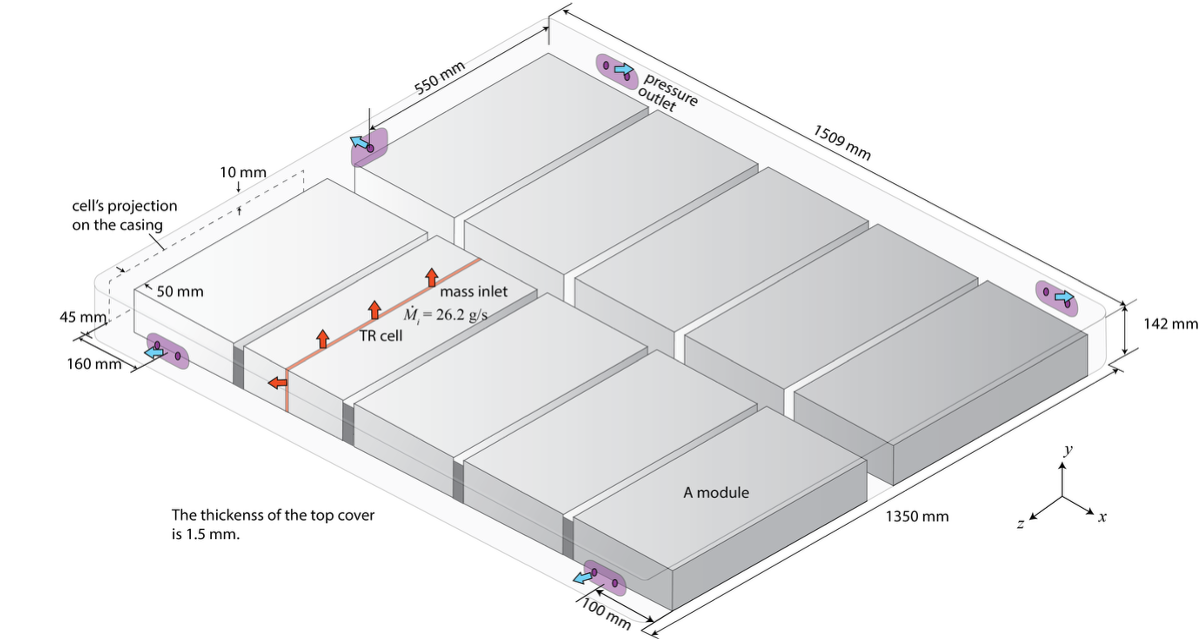
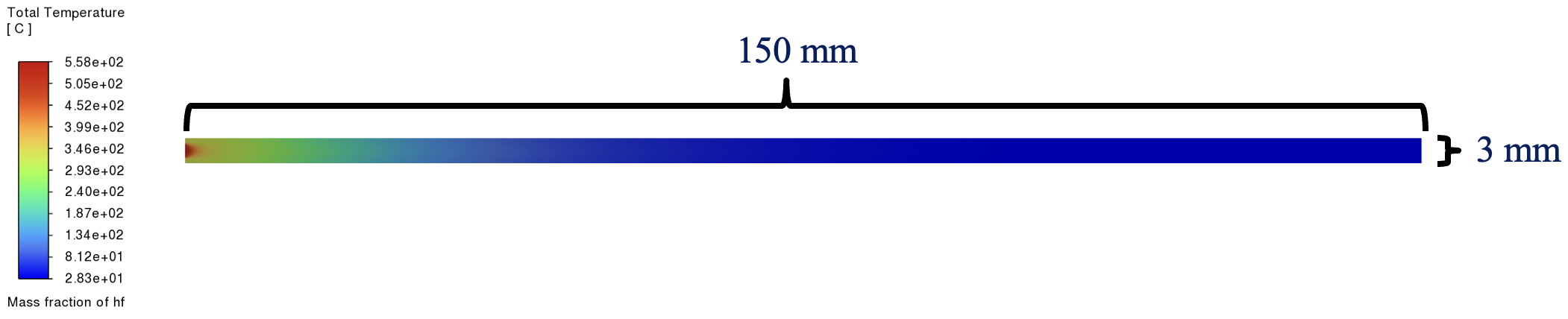
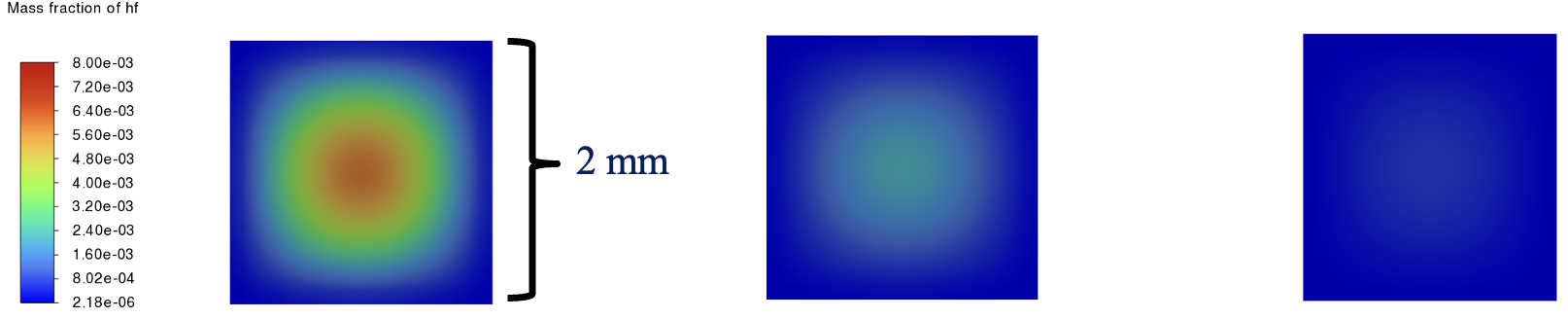
We analyzed the fate of thermal-runaway (TR) product gas in a GM Blazer EV battery pack and designed add-on components to keep pressure, temperature, HF, and particles within safety limits. Using literature data and CFD, we estimated gas and particulate loads for 1-cell and 6-cell TR events, then simulated how heat was stored in the pack casing and in alumina honeycomb monoliths placed at the vents. A CaO-based washcoat on the monolith walls provided dry scrubbing to convert HF into solid CaF2, while a corrugated metallic vent filter, inspired by commercial VentPlus units, spread particle deposition over a larger area to keep deposits thin and contained. Together, these elements illustrated a compact, passive strategy for TR heat and product-gas mitigation in EV packs.

Thermal runaway system figure Thermal runaway simulation figure Thermal runaway mitigation result figure

Snail-Inspired Robot for Marine Microplastic Removal

T. Hu, et al.
Capstone Design, University of Michigan, Winter 2025

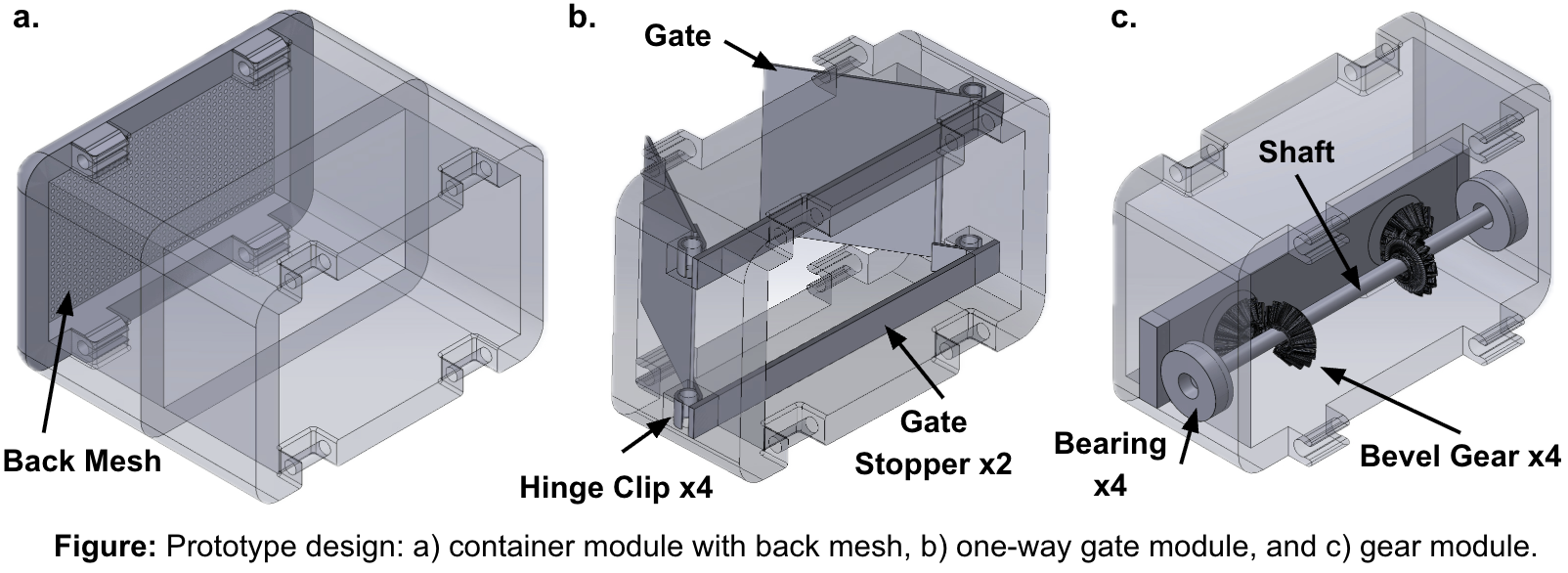
This project developed a snail-inspired surface robot that collected 0.1–5 mm microplastics using an undulating intake plate and a modular collection system. The collector I designed was organized into three swappable modules: a container module with rear mesh for drainage, a one-way gate module that admitted particles while resisting backflow and larger debris, and a gear module that mechanically linked the intake plate to the rest of the system. Together, these modules created a compact, reconfigurable “collector cartridge” that could be installed, removed, and upgraded without altering the main robot platform.

Snail-inspired robot collector design figure